
Dollar Spot Management; An Integrated Approach

Dollar Spot Management; An Integrated Approach
As temperatures and humidity increase across the country, reports of Dollar Spot incidence are on the rise. True to its name, Dollar Spot is a costly disease in terms of turf damage and curative fungicide applications and is the most expensive turf disease in North America.
Although dollar spot can be managed curatively, supers will find they are chasing outbreaks all season long. The good news is that research is advancing our understanding of this disease, enabling us to achieve better outcomes long-term using an integrated approach. This article compiles the most recent research to assist you in effectively managing dollar spot this season and hopefully beyond.1
What you need to know
This disease thrives in temperatures between 15-30°C with high humidity (70% or greater) being the key factor in its development. It is identified by small, circular infection centers and hourglass-shaped leaf lesions, caused by the Ascomycete Clarireedia jacksonii or a closely related Clarireedia species.
Overseeding for long-term results
No grass cultivar is completely resistant to this disease, and creeping bentgrass and annual bluegrass tend to be quite vulnerable. There are bentgrass varieties that show higher resistance than others, like L-93. Implementing cultivars or varieties with dollar spot resistance through overseeding, even as a blend, is the most viable long-term strategy for managing this disease. For variety selection, see the National Turfgrass Evaluation Program (NTEP) information page.
Resistance management
Research from Tom Hsiang’s lab at the University of Guelph has found widespread DMI resistance in Clarireedia jacksonii populations across Ontario golf courses. In fact, 12 of 13 golf courses that tested positive for dollar spot also had DMI-resistant strains. That makes resistance management more important than ever. The best approach is to rotate chemistries and integrate biofungicides like Rhapsody® ASO, which can help reduce resistant dollar spot populations when used with a DMI, as a rotation partner—or ideally, both.6
Impactful cultural practices
Frequent, vigorous morning dew removal combined with daily mowing and morning rolling has been shown to reduce dollar spot by 50% to 80%, even with extended fungicide intervals.4 Fertility also plays a role: higher nitrogen rates can reduce dollar spot, with benefits observed up to 29.3 kg N/ha and when leaf tissue nitrogen is maintained above 4.5% to 5%.1,2 High rates of ferrous sulfate have also reduced disease severity, with iron identified as the key factor.3 Irrigation timing is also important. Despite the link between humidity and disease, daily nighttime irrigation is recommended since dollar spot is associated with low soil moisture.5
The optimal fungicide schedule
There are three common types of fungicide scheduling programs – threshold, calendar and model based. Threshold schedules are reactive, involving curative applications after visible signs of dollar spot. This method is not recommended because by the time dollar spot appears, there is already a high fungal inoculum deeper in the grass, leading to continuous outbreaks and damage throughout the season. Calendar-based schedules, which typically involve applications every 14 days, are effective but can be costly. The ideal schedule uses a forecasting model, such as the Smith-Kerns model, to predict dollar spot outbreaks. This proactive approach has shown the greatest success and is more cost-effective, often extending application intervals up to 21-28 days.
Smith-Kerns for precise applications
The Smith-Kerns model provides an optimal solution. Why does it work? The load of fungi in your grass is high just before outbreak – applications timed before you see the damage when conditions are right will disable the disease in its tracks before it does the most damage. Using a logistic regression to predict disease based on a 5-day moving average of temperature and humidity, this model calculates a daily risk index with high accuracy. Applications are recommended when the model reaches or exceeds 20%. Dr. Koch’s lab in Wisconsin has a free excel file you can use to calculate this model using your local temperature and humidity. You can use our TurfView™ platform to view your golf course location’s model in real-time.
For our Stressgard® Advantage Club Members:
Envu’s TurfView™ platform (FIG 1. below) also utilizes this predictive model to assist customers in saving extra applications when the model is below 20%.
Here's how it works
In mid to low pressure areas, when the Smith-Kerns dollar spot risk reaches 20% or higher, make your first targeted 28-day application, typically around mid-May. From there, let the model guide your next applications—reapplying when the graph reaches 20% or higher. Already started on a calendar program? No problem. You can switch to the predictive model anytime to help time preventative applications more precisely. Open TurfView™ to access your local dollar spot model, powered by real-time temperature and humidity data for your location
For high pressure sites, use a conservative target closer to the 10% risk threshold.
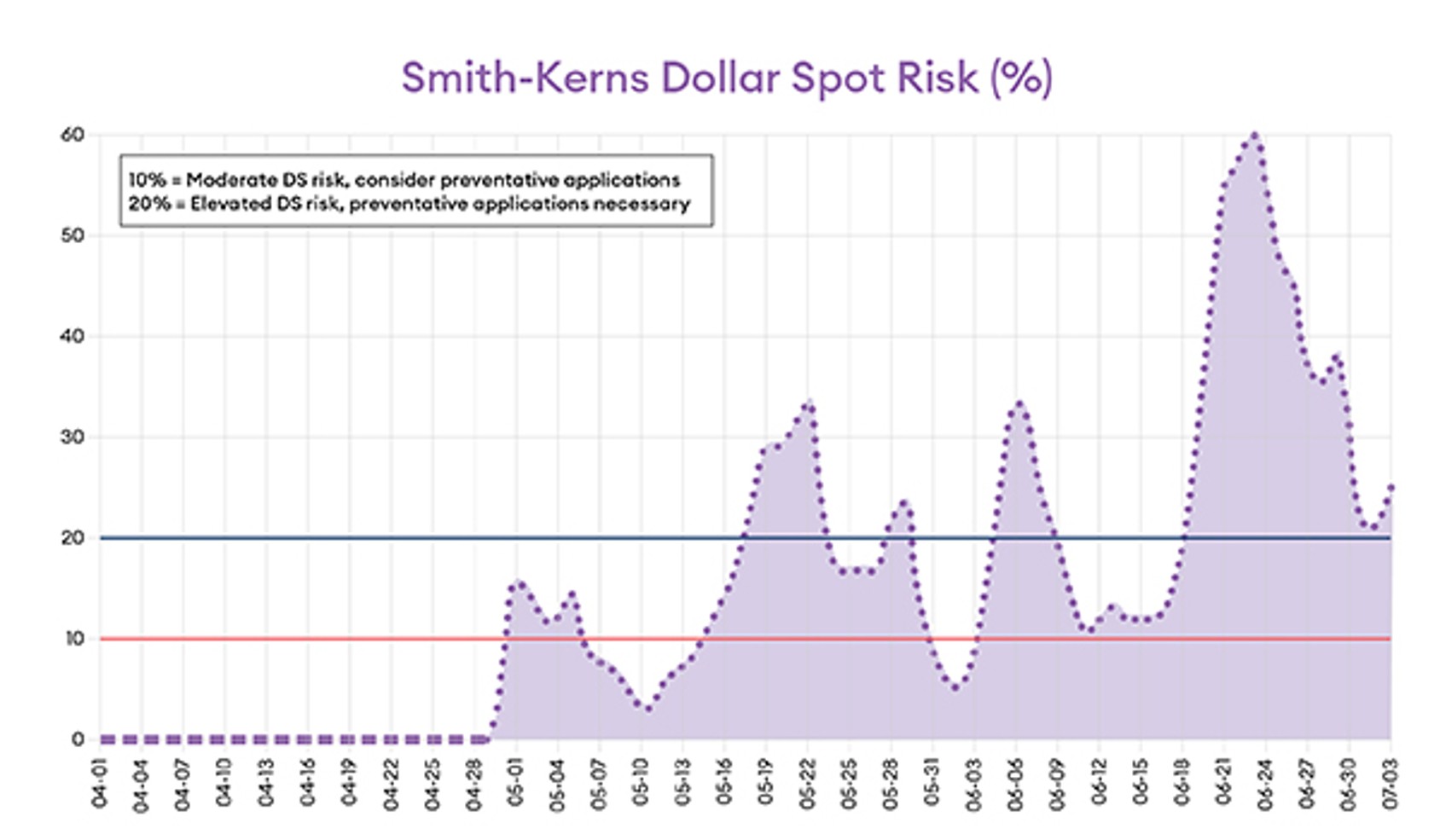
Since dollar spot is a foliar disease, select spray nozzles and spray volumes that provide good coverage to maximize fungicide activity. Integrating cultural and chemical control strategies with the latest research information provides the most effective control of this fungal disease long term.
Envu fungicide program
Fame® SC brings a unique QoI option to your dollar spot program, with a distinct chemical configuration and broad-spectrum control of 11 key turf diseases. As one of the only QoI fungicides labelled for dollar spot control, Fame SC is a valuable tool under light to moderate pressure and a smart rotation partner with DMI or SDHI actives to help protect long-term program performance. When pressure is high, pair Fame SC with a DMI for a powerful tank-mix approach for your dollar spot strategy.
Exteris® Stressgard® delivers powerful fairway protection with the combined strength of fluopyram, a novel SDHI active ingredient, and trifloxystrobin. Built for long-lasting preventative and fast curative control, Exteris Stressgard helps defend against key foliar diseases including dollar spot, anthracnose, brown patch and leaf spot—providing 14–28 days of dollar spot control confidence when fairways need it most.
Rhapsody® ASO brings biological power to your dollar spot program as Canada’s only turf biofungicide labelled for suppression of dollar spot, anthracnose and brown patch. Built to complement leading chemistries, Rhapsody ASO is a strong rotation or tank-mix partner with DMIs, QoIs and SDHIs—helping enhance program performance while supporting resistance management against DMI-resistant dollar spot pathogens found in Canada. Make Rhapsody ASO part of your strategy to stay ahead in the fight against dollar spot. Use our Quick Use Guide for more ways to benefit from using Rhapsody in your turf program.
For more information about dollar spot, download the solution sheet or contact your local Territory Sales Manager for dollar spot control strategies specific to your needs.
- Townsend, R., Millican, M.D., Smith, D., Nangle, E., Hockemeyer, K., Soldat, D. and Koch, P.L., 2021. Dollar spot suppression on creeping bentgrass in response to repeated foliar nitrogen applications. Plant Disease, 105(2), pp.276-284.
- Davis, J.G. and Dernoeden, P.H., 2002. Dollar spot severity, tissue nitrogen, and soil microbial activity in bentgrass as influenced by nitrogen source. Crop science, 42(2), pp.480-488.
- McCall, D.S., Ervin, E.H., Shelton, C.D., Reams, N. and Askew, S.D., 2017. Influence of ferrous sulfate and its elemental components on dollar spot suppression. Crop Science, 57(2), pp.581-586.
- Delvalle, T.C., Landschoot, P.J. and Kaminski, J.E., 2011. Effects of dew removal and mowing frequency on fungicide performance for dollar spot control. Plant disease, 95(11), pp.1427-1432.
- Dykema, N.M., 2014. Impact of irrigation regime and host cultivar on dollar spot of creeping bentgrass. Michigan State University.
- McNab, E., & Hsiang, T. (2025). A practical field assay to detect demethylation inhibitor fungicide resistance in Clarireedia jacksonii. International Turfgrass Society Research Journal, 15, 262–266. https://doi.org/10.1002/its2.173